
Why 16 Beds Beats 8 in Assisted Living
Sep 18, 2026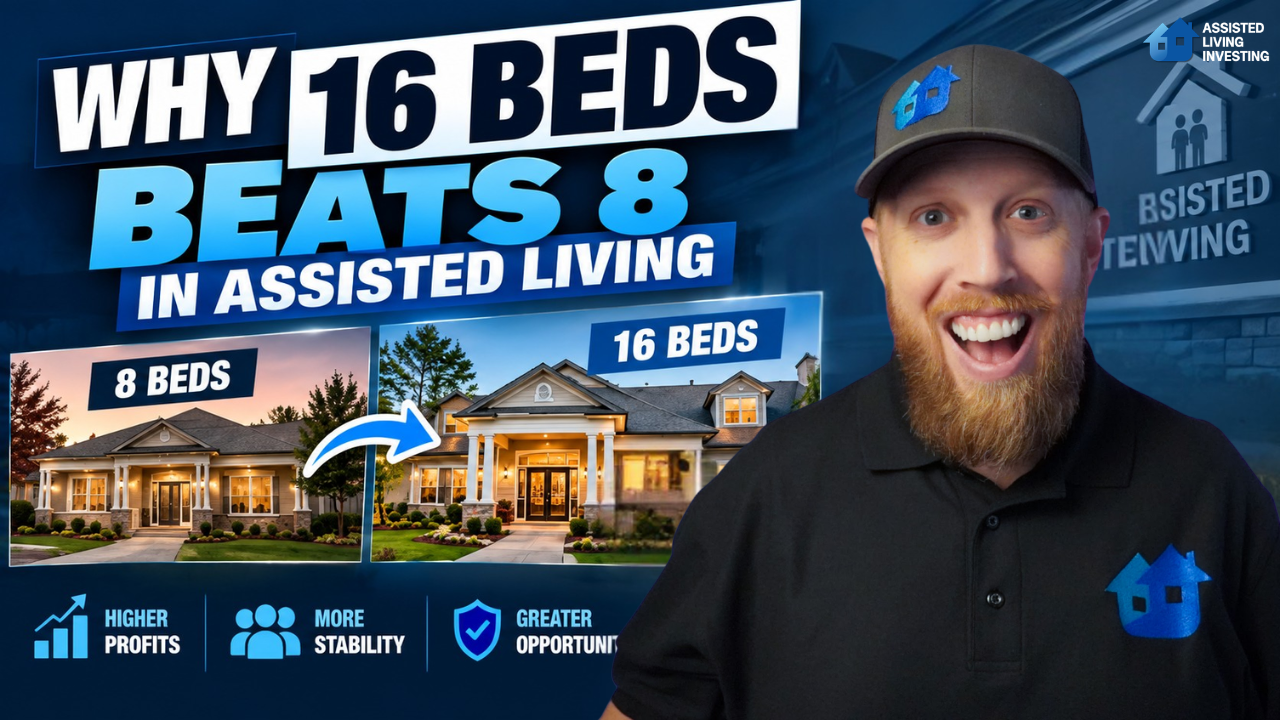
Have you been trying to figure out how many beds your assisted living facility should have? I’ve seen many people get stuck trying to decide between a small home and a larger facility, especially when they are unsure how the numbers work. Let’s look at why 16 beds may make more sense than 8 and what you should consider before getting started.
Want the full breakdown? Watch the video below👇
More Residents Can Help You Reach Your Financial Goals
One of the biggest differences between a small and large assisted living facility is how much money you can bring in each month.
Let’s say you charge $5,000 per resident each month. With 5 residents, you would bring in $25,000 in monthly revenue. If your expenses are $20,000, you would have $5,000 left.
But what happens when one resident moves out or passes away? You lose $5,000 in revenue. Now you are no longer making money.
With 10 residents, the numbers look different. At the same rate, you would bring in $50,000 each month. If your expenses are $35,000, you would have $15,000 left.
Even if two residents leave, you could still have $5,000 left.
💡 More beds can give you more room to handle changes in occupancy without losing money.
Staffing Depends on the Care Your Residents Need
You might think a 16-bed facility always needs twice as many staff as an 8-bed facility. But that is not always how it works.
In many states, staffing rules focus on meeting the care needs of your residents instead of using one fixed staff-to-resident ratio. The number of staff you need will depend on the people you serve and the help they need.
For example, an 8-bed home serving residents with high care needs may need two staff members on each shift. A 16-bed home with more independent residents may need fewer staff than you expect.
Staffing is one of your biggest expenses, so you need to plan for it carefully.
✅ Think about these questions before choosing your facility size:
-
Who do you want to serve?
-
How much help will your residents need each day?
-
How many staff members will you need on each shift?
-
Can your revenue cover those staffing costs?
A Bigger Facility Can Give You More Room to Make Money
Let’s look at another example. What if you have 10 residents and charge $10,000 per month?
That gives you $100,000 in monthly revenue. If your expenses are $50,000, you could have $50,000 left when your facility is full.
Even at 60% occupancy, you could still have $10,000 left in this example.
Now compare that to a small home with just 5 residents paying the same rate. You may have strong revenue, but losing one or two residents can have a big impact on your income.
This is why I encourage you to look beyond the number of bedrooms in a property. You need to understand how many residents you can serve and what your expenses will be.
If you want to work through these numbers, join my free workshop . I’ll help you understand the finances of running an assisted living business.
Licensing Costs May Be Different, but the Process Is Similar
You may think a smaller home will be much easier to license. But the licensing process may not be very different from a larger facility.
A smaller home may have a lower base licensing fee. You may also pay a fee for each bed, so a larger facility can cost more to license.
But the difference in licensing costs may be small compared to the money you can bring in over time.
Before you choose a property, find out how many residents you can legally serve and what your state requires.
✅ Look at the maximum number of beds your property can support and plan your licensing around that.
Choose a Facility Size That Matches Your Goals and Your Risk
A small assisted living home can be a good fit for some people. If you want to serve a special group of residents and charge higher rates, a smaller facility may make sense.
But if you want more time and financial freedom, you need to think about how much work you will be doing. With only a few residents, you may end up doing most of the care yourself. That can turn your business into a full-time job.
A larger facility can give you more room to spread out your expenses. However, it also means more residents, more staff, and more chances for things to go wrong. You will need good insurance, clear policies, and strong processes.
The key is to understand your risks before you get started.
Wrap Up
Before you choose between 8 beds and 16 beds, run the numbers. Figure out how many residents you need, what you can charge, and whether your business can reach your goals at 80% occupancy.
If you want to build an assisted living business that supports your life, start with a plan and take it one step at a time.
____________________________________________________________________________________________________
If you need help creating a business plan for your assisted living business, check out the Free Business Plan Checklist.
And if you’re ready to figure out your next step, join me for the next Roadmap Challenge where I’ll walk you through how to get started.
Show full transcript 👇
Transcript
00:00:00
Have you been trying to figure out the right size of assisted living facility for yourself? Maybe you're thinking, ah, four bedrooms or six or eight or 10 or 12 or 16 or 20 or 100 and you're just not sure which one makes the most sense or why why one of them might make more sense than another one. Well, in today's video, 8 versus 16 bed assisted living, which one makes more sense? I'm going to give you a little bit clarity on that uh to help you understand exactly which size is going to work best for you and
00:00:32
why you might consider a smaller facility versus a bigger facility and help you understand why you might choose one of those and what exactly you should be looking for. And the reason why I've created this video is I've seen a lot of people that just don't understand exactly how the numbers work. um you're un unsure of how the scale of doing more beds is actually going to impact your operations and your ability to be profitable. And I just want to help you get some clarity on what the right size
00:01:01
is for you and how you should move forward. Hey friend, I'm Brandon Gustafson. I help healthcare workers start their own assisted living business so they're not stuck trying to figure it out and know exactly what they should do next. If you need some help as you're going through this process, make sure you go check out assisted livinginvesting.net. I have a few resources over there for you. And if you know you need help, but you're not sure like the best option for you, go take my
00:01:25
quiz, aliquiz.com. We'll have it down here in one of these corners so that you can go and take the quiz. 30 seconds will point you in the right direction and help you know exactly what you should be doing to help you launch your assisted living business. All right, let's start talking here. Again, today the video is 8 bed versus 16 bed assisted living. Which one makes the most sense for you? And now I'm going to specifically talk only about 8 and 16 bed facilities, but I want you to
00:01:52
understand the difference when it comes to a few different things. First, start talking about staffing. Smaller facilities, four to 10 beds we're going to say, versus something that's larger, 12 to 20 beds. Is there a difference in staffing? Now, in most states, what I see, and this has been a trend over about the last year, year and a half, is most states are shifting away from a specific ratio, a resident to caregiver ratio. It used to be that you had to have, you know, one staff for every eight residents or 10 residents or
00:02:24
whatever. And the majority of rules in almost every state, I would say, we're probably 90% of all states follow this rule. Now, it says you have to meet the care needs of the resident. Okay? So, if you have a resident or a bunch of residents that don't need a lot of cares, they are pretty self-sufficient, then you don't need a ton of staff. Unless that's what you want to do, you want to cater to a higher clientele and you want to really promote that you have this great resident to caregiver ratio,
00:02:53
then cool, that's up to you. But the rules and regulations actually state in most states that you just have to meet the care needs of the residents. So, as long as you're doing that, you're in a pretty good spot. That's going to depend in in a lot of instances how many staff you actually need. So, it will depend honestly on the type of care. What you may find is in a smaller home, let's say that it's eight residents. If it is memory care and people that are near end of life and they're just really heavy on
00:03:24
on care needs, uh you have people multiple residents that need a multi-person lift, you might need to have two staff for every single shift. Whereas you could have a 16 bed facility that everybody is really independent and self-sufficient and you don't need a lot. would just need one staff there or maybe just need two to just cover it so that you have somebody helping out with meal prep and in case you have, you know, multiple people calling because they need help on the toilet or something like that, you can go in and
00:03:50
you can help them, but there's not going to be a stipulation that says you have to have a certain amount of staffer, a certain amount of residents. A lot of that has gone away. So, the staffing is going to be very specific to the needs of your residents. So, I can't really answer you super well because I don't know what residents you have. What resident, by the way, type this in the chat below. Are you planning on serving? And what type of help do they typically need? You might not know this, but I
00:04:20
would love to hear from you. Like, who do you want to serve? And what do you anticipate from a staffing perspective? And if you put a number in there, I might be able to give you some directional guidance and say, "Yeah, that seems about right." Or, "That seems maybe a little light or that seems excessive. you probably don't need that many staff. This is a really important thing for you to understand, by the way, because staffing is your biggest expense. And the more you can hone in on your
00:04:44
staffing, the better off you're going to be. If you want some help with that, come join me in my next workshop. It's free live workshop. Just type in workshop down in the comments below or go to assistedlivinginvesting.net/workshop. One of the things we talk about there is your money and the finances of owning an assisted living business. and I'm going to give you some clarity on exactly how you can figure out how many staff you really need. So, come check that out. Now, the next thing that I want to talk
00:05:10
to you about because staffing is a big one. I think it creates a lot of confusion, but the reality of it is it kind of depends on the residents and what their needs are. And as long as you're meeting their needs, you're going to be in a good spot. Okay. The other one that I want to point out to you is your revenue and your margin differences are going to be vastly different in small facilities versus large facilities. So, I'm going to try to illustrate this for you. So, we're going
00:05:32
to use this example, right? We've got five residents in a home, uh, $5,000 per month. So, that's $25,000 in revenue. That's the example we're going to use here just to kind of illustrate our point. Now, if I have that, and again, I teach in the workshop, go sign up assisted livinginvesting.net/workshop or just type in workshop down below. We'll get you the link how this all works and and kind of illustrate this out for you. But you're going to have a certain amount of expenses when it comes
00:05:58
to running that business. I'm just going to focus on revenue right now because I I don't know exactly how to quickly illustrate the wife expenses. And if you want to learn more about those and kind of see this the expense piece of this, just type in wife. Wedd stands for wages, insurance, food, energy, which is your utilities, and debt service, which is like your lease payment, your rent payment, um your mortgage payment. Okay, those things all need to be taken into consideration so you can see exactly what your margin is
00:06:26
going to look like. But let's look specifically at revenue right now. Five residents, $5,000 a month, $25,000 in revenue. Sounds great, right? But let's say you have $20,000 in expenses. That's $5,000 that you're cash flowing. And let's say that with those five residents, you have one pass away or you have two, they just decide to leave or they have to go to the hospital. They're there for an extended period of time. you've lost $5,000 per month for every resident that's out. So, if you were
00:06:55
cash flowing $5,000 per month and you lose one resident, you don't cash flow anything. You lose two residents, you're losing $5,000 a month. This is where having small homes is really, really hard. Now, let's flip that around and let's say that we have 10 residents at $5,000 per month. Okay? So, we're not going to change that that monthly amount that we're bringing in. We're changing it to 10 residents. So, we got uh $50,000 per month right there in total revenue. Our expenses will probably go
00:07:24
up a little bit, but they're not going to like double like what we just showed, the $20,000 in expenses for a five-bedroom home. We're going to say they go up to let's say it's $35,000. Okay, it's not doubling, but it's getting close to doubling it just to to illustrate this for you. So, what I've got here, $50,000 in revenue, $35,000 in expenses, that's $15,000 in profit that's coming into my business if I'm 100% full. But let's say that I've lost one resident, one passes
00:07:52
away, and I've got another one that's at a hospital, right? Uh now, I've lost two residents for the entire month. That's $10,000 down the drain. I'm not going to see that money. And this is, I would say, pretty realistic that you're going to sit at an 80% occupancy. I am still making $5,000 per month off of the off of this this opportunity. Whereas, if I had lost those two residents in the five-bedroom home, I'm losing $5,000 a month, right? I could actually lose in this scenario, 10 residents, $5,000 a
00:08:20
month. I could lose another one and still be breaking even. I could be a 70% occupancy and still be fine and still not be losing money, heavening cash. Okay, this is where having more residents is going to benefit you. Now, let's flip this around and let's say that we're able to charge more. Let's say we have really high-end space, right? We're we're at five residents, but we're charging $10,000 a month for easy math. That's $50,000 in revenue, which is great. Where our expenses are
00:08:49
probably go up exponentially. They might go up a little bit because we've like hired a private chef or something. So, we're at $25,000 for our total expenses. That's $25,000 in profit, right? We lose one resident, we're still making 15,000. We lose two residents, we're still making 5,000. We're still we're still in a pretty good spot, which is great, right? But let's say we have those 10 residents and we charge them $10,000 a month. That's $100,000 in revenue. And
00:09:13
let's say we're going all out, going crazy with this. And our expenses are now at $50,000. Like, we're doing everything. We have a movie theater. Like, we got all this stuff in our home, right? It's perfect. It's beautiful. Even in that scenario, having 50% occupancy, at that point, we would finally be breaking even. Otherwise, we're going to be making at 60% occupancy, $10,000 a month. At 100% occupancy, we're making $50,000 per month. So, this really, I hope, illustrates for you the idea that the
00:09:44
the more residents you have, this is a big lever that you can pull. And so, for those of you who are thinking, I I have this perfect three-bedroom home. I could turn it into a small care home. You are still going to have high expenses. And those expenses are going to come in two ways. one, you're going to have to hire somebody to do the work for you, which is expensive. Or maybe you're like, I'm not going to do that. I'm just going to do all the care for by myself. Cool. Now you have created a job for yourself.
00:10:13
This is now your full-time employment. You basically live with these people. You don't get a lot of breaks. You might be able to do some respit care, but you are very much stuck in this area. So, you're paying with your time. So, if you want time and financial freedom, small homes, three, four, five residents, six residents, probably don't make a lot of sense. If you want time and financial freedom, doing something with 10, 15, 20 plus residents in a home is probably going to be a better fit for you. So, I
00:10:44
hope that illustrates that and what that looks like because the revenue and the margin differences there are significant. So, what is your goal? Do you want time freedom? Do you want financial freedom? Do you want both? Type that in the comments down below. Super interested in hearing where you're at, what your main goal is, what your driver is, and tell me a little bit. How many residents are you thinking to have in your facility? And what are you thinking to charge them? Because I can tell you if I think that's going to be
00:11:11
realistic. If you're like, "Five residents, I'm going to charge them $3,000 a month." I might tell you, pump the brakes a little bit [laughter] right there, right? But if you're telling me, I want 20 residents and we're going to charge like four or $5,000 a month. Yeah. I think you probably have a pretty decent chance at making some really good money at that point. Type those things down in the chat. Would love to hear from you there. Now, I do want to be clear with you when it comes to
00:11:35
licensing with these different size of facilities. The process is actually going to be pretty similar. The cost to get licensed is going to be different. It will cost you less when it comes to doing a smaller home because typically that license level is a little bit lower than you would see in a larger home. So there's a lower base fee, but also there's a per bed fee that you have to do when you do your licensing. So the more residents you have, the more beds you're going to have to pay for when you
00:12:02
do your licensing. Now, this isn't a significant amount. The difference of maybe a couple thousand in the scheme of things, it pays for itself over time. So, don't let that $2,000 difference be the thing that's like, "Well, I can't do 10 beds because all I have money for right now is six, and so that's what I got to do." Don't have that be the thing that holds you back. What I highly suggest you do is the maximum amount that you can fit into your property. That's what you should
00:12:34
get licensed for. Maximize everything out. Okay? But the complexity of doing the license is not that different, honestly. So, it's not like you're saving yourself some headaches and some time with the application when you do a smaller home. It's going to be pretty much the same thing. Okay. Now, let's talk about the risk differences of a small home versus a large home. In a small home, I think your biggest risk is your ability to be profitable. We just shared that example. you can very
00:13:05
quickly get to a point where you're losing lots and lots of money on a like very quickly and that can be really hard. So, you have to be extremely confident in your ability to fill the beds even when something horrible happens like a resident passes away because it's going to happen. We had like I think we had two just like in the past month pass away. We we've had several. It just happens like this the nature of this business, right? people are old and they're at the end of life. It's going to happen. So, you
00:13:36
might know exactly who those four or five people are that you're going to bring in today, but what happens when one of them passes away or decides that they want to move somewhere else or they need to go into the hospital for whatever reason? They have to be in a rehab facility and you can't collect money from them because they're not actually in your home anymore. What are you going to do in that scenario? That is where there's a huge risk with small homes. Now, on the flip side, with a
00:13:59
larger home, you have more opportunities for liability issues to come up. You have more opportunities for a resident to slip and fall, for have more staff that are doing things they shouldn't be doing. You just have a bigger operation. So, you're exposing yourself to more liability, which means your insurance costs might be a little bit higher, but it's not going to be like significantly higher than it would be in a small home. You're still going to need insurance. You're still going to need to run the
00:14:22
business. You're still going to need to have staff. you're still going to need to have uh policies and procedures in place to mitigate uh some of those big risks. So, you have to decide for yourself, what am I most comfortable with? Am I most comfortable with having this really small intimate home where I realize that I could be losing a lot of money very quickly at the push of a button or something bad happens? Or am I just like I don't want to expose myself to a lot of liability because I don't
00:14:50
know what that uh entails. Now, I want to tell you, you can get really good insurance. It's not going to cost you that much. You build in good policies and procedures. You have really solid processes for bringing in new staff and new residents, you're going to be in a pretty good spot. So, I don't think the liability thing should scare you all that much, but I also want to acknowledge it could be something that scares you. Okay? But those are the biggest risks there. And obviously, even
00:15:16
in a large home, you have the risk of losing money. This is a business. This is not a guaranteed thing. You have to have the plan. You have to work the plan. You have to adjust the plan accordingly. And that's what's going to allow you to be successful. But you need to do those things. That's what's going to help you actually get there. So, which is the best fit for a beginner? I can't answer that for you because I don't know your specific situation or your specific goals.
00:15:41
If it were me, I personally don't like looking at anything less than 10 beds. Like, that just is outside of my comfort zone. Does not mean that you shouldn't look for that. I have had students in the past in my success system program who have looked at doing six bed facilities and they're charging higher rates because of the specific niche they want to be in and the market where they are located. And I think it makes a lot of sense for them. But I coach them through the process of what I just
00:16:08
shared with you, especially with the revenue that you have to make dang sure that you're going to reach your financial goals and not put yourself in a spot where you're losing tens of thousands of dollars per month. because I don't want that for you at all. So, what's the best fit for beginners? I would say the best thing that you could do is actually start building your foundation right now. Start running the numbers. Type in calculator if you need access to the underwriting calculator.
00:16:35
Start getting familiar with those numbers. Start figuring out how many residents would I actually need for this to be profitable to hit my profitability goal. And can I do that at what occupancy rate? Can I do that at 80% occupancy? I think you're probably good at that point. I would feel pretty comfortable. If you have a goal of $10,000 per month and you can hit that consistently at 80% occupancy, I think you got a solid deal in front of you. Okay, that's what I would share with you. So, if you found
00:17:02
this video to be helpful, make sure you like the video, subscribe, ring the bell as well so you get notified every time we put out content like this. Helps other people find the channel as well to help them out as they're trying to launch their own assisted living business in this world that needs so much help with assisted living. And if you want some help in kind of working these numbers and seeing it, type in workshop so I can get you access to that. And if you are like, I I want to work with Brandon, but I don't know
00:17:24
which program is best, take the quiz, aliqu, scan the QR code. It will be down here below in one of these bottom corners and help you out along your path to launching your assisted living business. Are you curious about assisted living, but you're not sure how to get started at assisted living investing? I help healthcare workers start their own assisted living business so they're not stuck trying to figure it out and know exactly what they should do next. And I want to remind you that it doesn't take
00:17:48
a lot, just a little bit. Just keep going step by step by step. And I promise you, if you do and you are consistent and persistent, you are going to be successful. Hey, it's future Brandon. I totally forgot when I was recording a little bit earlier today that I needed to remind you. If you found this video helpful, make sure you go and watch this video. We're going to watch that one. Okay? And hey, if if you don't like that one, but you want to watch another one, watch the other one
00:18:11
that YouTube's going to recommend for you up there as well. Okay, thanks for watching and have a great day.
Download Your FREE Calculator
Stay connected with news and updates!
Join our mailing list to receive the latest news and updates from our team.
Don't worry, your information will not be shared.
We hate SPAM. We will never sell your information, for any reason.