
Never Buy These 5 Types of Homes for Assisted Living
Oct 16, 2026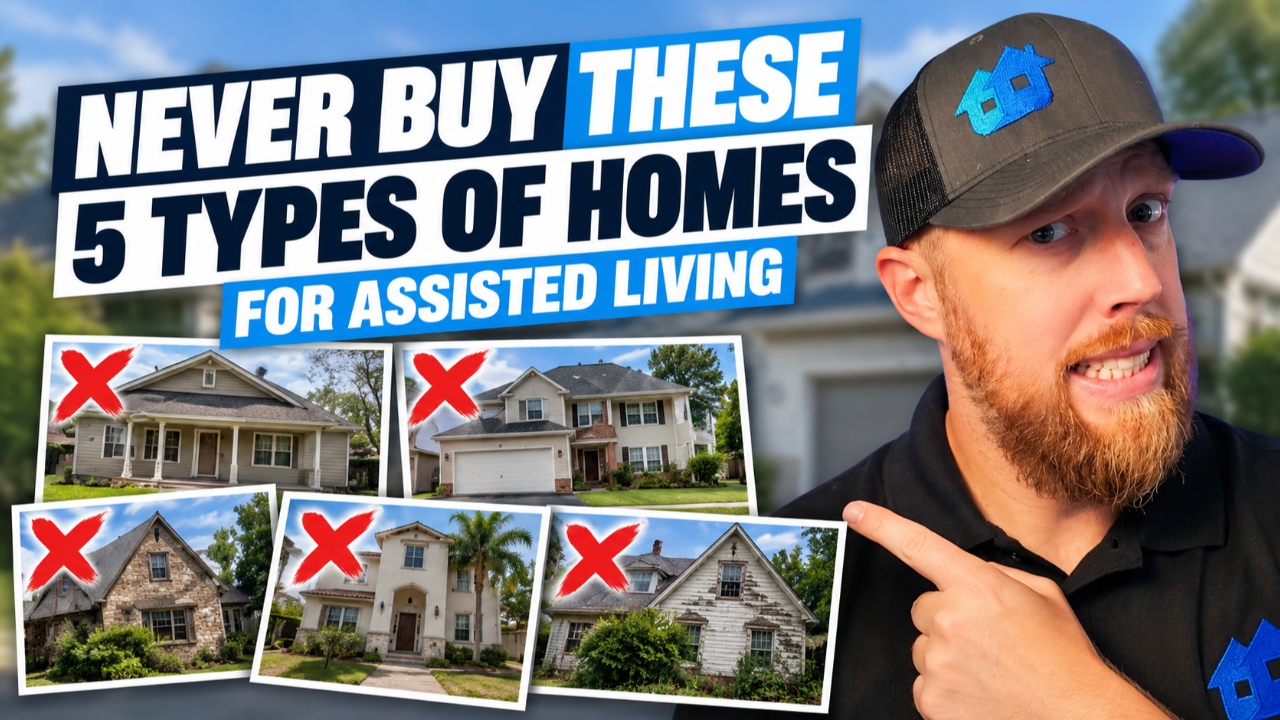
Buying a home for your assisted living business is a big step, and I know how exciting it can be to find a property that looks perfect. But I have seen how the wrong home can make it harder to fill beds, manage costs, and build a business that works.
Want the full breakdown? Watch the video below👇
1. Avoid Homes With Too Many Stairs
A home with several floors may look great, but stairs can limit the residents you can serve. I learned this the hard way after running an assisted living facility with lots of stairs for more than five years.
Our home worked for many of our younger residents who had mental health needs. But when we wanted to serve more older adults, the stairs became a problem. Some residents could not safely use the upper floors, which limited the rooms we could offer.
You might be able to add a chairlift or elevator, but these changes can cost a lot of money. They can also need repairs and ongoing care.
Before you buy, ask yourself these questions:
✅ Can my future residents safely use the stairs?
✅ Can I use all the bedrooms in the home?
✅ Will I need to spend extra money to make the home work?
A home with fewer stairs may give you more options as your business grows.
2. Avoid Homes With Too Few Bedrooms
A small home may seem like an easy way to start your assisted living business. But fewer bedrooms can make it harder to earn enough money to cover your costs.
Let's say you have four rooms and charge $5,000 per resident each month. That gives you $20,000 in monthly revenue. But revenue is not the same as profit.
You still need to pay wages, insurance, food, energy, and debt service. I call these the WIFE expenses. In my example, those costs could add up to about $15,000 each month.
That leaves $5,000 before any extra costs. If you have empty beds or your expenses go up, that money can disappear fast.
💡 My advice is to study the numbers before you buy. I prefer to look for homes with at least 10 beds because they can give the business more room to cover its costs. The right size still depends on your care model, local rules, and the money you need to run the home.
3. Be Careful When Buying a Home With an HOA
An HOA, or homeowners association, sets rules for a neighborhood. These rules can affect how you use your property and may make it harder to run an assisted living business.
I have operated a home in an HOA without major problems. Still, we sometimes received notices about parking, grocery deliveries, and other daily tasks.
These issues may sound small, but they can take time and energy away from running your business. HOA rules, bylaws, and other restrictions may also create bigger problems.
Before you buy, review the HOA rules and ask questions about how they apply to your plans. If the HOA pushes back or the rules seem unclear, consider getting help from an attorney who understands the issue.
You do not have to rule out every home in an HOA. Just understand the risks before you commit.
4. Do Not Assume an Unlicensed Facility Is the Easy Way to Start
Many new owners think an unlicensed facility is the fastest way to enter the assisted living business. But a faster start does not always mean an easier path.
An unlicensed facility may face higher insurance costs, fewer funding options, and concerns from families who want to see a license. You may also face changes in state rules that affect how you can operate.
I am not saying an unlicensed facility cannot work. I am saying you should understand the risks before choosing this path.
If you decide to move forward, build a strong foundation from the start.
✅ Create clear policies and procedures.
✅ Get the right insurance for your business.
✅ Learn the rules for your state and the type of care you plan to provide.
Always check your local licensing rules before buying a property. The goal is to build a business that can meet the rules and serve residents well.
5. Avoid Markets With Too Much Competition
A home can look perfect on paper and still be a poor choice if too many similar facilities serve the same area.
Do not assume you will succeed just because a large assisted living facility has opened nearby. A large facility may serve a different group of people, and smaller homes may be your real competition.
I teach a simple way to study a market called the three Ps.
-
People: How many people may need assisted living services?
-
Places: How many facilities already serve those people?
-
Positioning: What makes your business different from the other options?
For example, you may want to serve older adults, people who need memory care, or people with mental health needs. Find out how many facilities serve that same group.
A busy market is not always a bad market. It may have enough people who need care to support more facilities. The key is to do your research before you buy.
Wrap Up
I made the mistake of rushing into a property because I wanted to get started. Over time, I learned that the right home is about much more than its size, number of bedrooms, or price. You need to study the costs, the rules, the residents you want to serve, and the competition before you make a decision.
If you need help creating a business plan for your assisted living business, check out the Business Plan Checklist.
And if you’re ready to figure out your next step, join me for the next Roadmap Challenge where I’ll walk you through how to get started.
Show full transcript 👇
Transcript
00:00:00
I have talked to literally hundreds of people just like you who are trying to start their own assisted living business. And what I have heard through that is horror stories of people starting their own assisted living business and the way they did it wrong. I actually did this with this house right here. I made a horrible decision by just rushing into it and not building my foundation the way that I needed to and understanding the ins and outs of getting into assisted living. So, in this video, I'm going to tell you the
00:00:28
five types of homes that I would very strongly caution you against getting into when it comes to assisted living. And make sure you stick around for number four. Four is the one that everybody thinks is the easy path, but actually it's not. I'm going to tell you exactly why. All right, let's get into it. And if you found this helpful, make sure you go and check out the free workshop down below. There's a link in the pinned comment. Would love to have you over there. All right, let's get
00:00:50
into it. Let's talk about number one. The first type of home that I would tell you, hey, you probably don't want to go with this type of home. And that type of home is a multilevel home. Now, I told you about this home that I bought that I kind of regret. And what you're going to notice here as you're looking at that home is it's tall, right? And look over there on the side. It actually has a fire escape with a ton of stairs on it. Now, stairs is not something that is going to make it, oh, I can't do
00:01:18
assisted living. It has stairs in it. Um, I I've got to stop. I got to look for something else. Does not absolutely mean that you cannot do that. But what it does mean is you need to be aware of the type of resident that you can bring in. Now, in this home, we served a population that dealt with mental health issues. So, they had bipolar or they were schizophrenic. Generally, they were younger, like a lot of our residents were between 30 and 50 years old. So, they were generally relatively healthy
00:01:46
from a physical standpoint. They could handle the stairs. But we did get to a point where we're like, "Hey, we would like to serve an elderly population here. We'd like to kind of bring them in." And as we started bringing them in for assessments, one of the big things that was a detractor for us was, gosh, there's so many stairs in this building. How are we going to allow somebody to come in? Maybe we can have them come in the ground floor and we bring food down, but then we only have like, you know,
00:02:10
two rooms down there where they're not on the stairs. It's maybe not the best fit for us. And it ended up becoming something that just made it really hard for us to operate and get and keep the beds filled if we wanted to shift our model. Now, working with a mental health population is not a bad thing. I love working with that group. They were like some of my favorite residents. So much fun to talk to. I loved these people. But also, they can be a little bit more difficult when it comes to just working
00:02:38
with them on a day-to-day basis. And so we would end up having a lot of turnover, probably more turnover there than we would with our other staff. And that made it a little bit hard for us as we were trying to get things off the ground and actually run a profitable business. And ultimately, we decided to sell this facility, which was fine for us. We decided on a different uh kind of demographic that we wanted to serve in a different geographic location. And step one of that was selling this facility.
00:03:05
And we were able to come out of it just fine. But what I would caution you strongly against is getting something with stairs because it can limit the type of population that you're going to serve. So before you look at a house and you start falling in love with the square footage and how many bedrooms it has, what I want you to ask is, are there stairs? And if there are stairs, can my residents handle those stairs? because you may have, you know, 12 bedrooms in a home, but if six of them are on the top floor and six are on the
00:03:34
bottom floor and you can't work with those stairs, then it's going to be a bit of a problem. And yeah, you can get a chairlift and you can get, you know, those little things that go on the railing that take people up and down or you can install an elevator and those are things that you could potentially do, but then you have something that also has mechanisms in it and you might have to hire somebody to come in and fix those things on a regular basis and it costs a lot of money to put them in. And
00:03:58
so don't just assume, hey, this is something that is always going to work for me because it's going to cost money to maintain as well. So doesn't mean you can't do it. Just I want you to be aware of it that stairs can be something that limit you. And in a perfect world, I would caution you against getting something with stairs, having done this and run one of these businesses with a ton of stairs for over 5 years. So again, we have five homes, five home types, right? And look at this beautiful
00:04:27
home. You know, we got architectures digest here of of homes that is just just I mean this is great, right? So, the first type that I'm going to say probably try to avoid is something with stairs. Okay. So, let's let's try to avoid that here as we're getting started. All right. The next type of home that I'm going to tell you to avoid is something with too few bedrooms. I talk to so many people out there, uh, people like you, and you'll put in the comments, "Hey, I want to do this. I've
00:04:58
got a four-bedroom home. Can I start my assisted living business here? I've got three bedrooms, but they're big. I can actually I could do something here, and I can make this work, and this is going to be great." Now, a lot of people don't understand is that even if I have, let's say I have four bedrooms in a home and I'm making $5,000 per room with that home, that equals $20,000 in revenue, right? Now, that is a huge word for you right there. It's the revenue word. That
00:05:29
is not profit because you're going to have expenses here. Okay? And those expenses, the the top expenses that I teach are what I call the wife expenses. And they stand for wages, insurance, food, energy, which is your utilities, and your debt service. So, if I have $20,000 in revenue right here, these expenses are going to be about 15,000 in in expenses. We're going to ballpark it. Okay. And now, what I I know you see here is, oh, cool. I do have enough money here. I've got $5,000 in in
00:06:05
potential uh income coming in, potential profit, right? That's cool. That's great. But what if your expenses are actually higher than 15,000? Or what if I can't charge more than 5,000 and I only have to I can only charge 3,000? Or what if I have less residents come in? What if I only can get three residents to come in at any given time? 3 * 5 is 15 minus 15,000. Now I'm not making any money. What if I lose two residents? Now I'm losing $5,000 per month. Okay. So what we need to understand is if we do
00:06:36
this the wrong way and we have a small home, our ability to be profitable shrinks significantly. And so having small homes, while yeah, on the surface it sounds like something that hey, I've got this home um like there's the the revenue potential for me to actually make a ton of money here when it comes to assisted living. I can get a lot of money coming in. You have to realize you are actually running a business. All right. So, we're going to say right here, we're just going to put the number
00:07:06
four for the amount of rooms, four rooms, something like that. We want to stay away from. I strongly encourage you to have, I would say, at least 10. And we're going to do a video on that to help you understand why I think 10 beds is like the base for me for what I'm going to look for. Small homes are not something that I think you should pursue because you don't understand the amount of money that you are going to have and expenses to actually run a profitable business. This is why I teach you inside
00:07:37
of my programs and go check out the workshop in the pinned comment down below to learn a little bit more about this. But this is why I tell you that you have got to figure out the underwriting the how the numbers work if you're going to be successful. Okay? So, don't do homes with few bedrooms. You're going to put yourself in a really bad situation if you do that. All right, let's move on to number three. Number three is, and I I've told you all that, hey, you can do this uh with this type
00:08:07
of in the past, but I'm going to tell you, you might want to try to avoid it. HOA. All right, HOAs are something that they are a thorn in people's side. It's just like a fact of life, [laughter] right? Now, if you're a property manager, you're you're one of those groups that actually runs HOAs and you love them, then, you know, good for you. But for the rest of us, what we think about HOAs are like, "This is dumb. Why am I paying money for something here?" And there are
00:08:35
things inside of an HOA, their CCNRs, their bylaws, the the things that that they have in place that can prohibit businesses from running in a home. Now, what they cannot do because of the Fair Housing Act is shut you down. Okay? you're you're going to be able to do this. However, they can still make your life extremely difficult and it might not be worth pursuing and fighting. So, when it comes to HOAs, then you you might want to skip out on it. Now, I am talking about this from experience
00:09:05
because one of my homes is in an HOA and we have actually not had any problems with it. What we do is we communicate and every now and then we'll get notices. They'll tell us, "Hey, you guys have too many cars parked out front or why is this happening?" or we we do large grocery orders with Walmart Plus and the people delivering the groceries, it takes them a while to get all the groceries out and they're parked in a spot where they shouldn't be parked. And you know, there are little things like
00:09:29
that that happen all the time with our facility. And so every now and then we'll get a letter that says, "Hey, why are you doing this?" And we just work through it and we communicate with them. Now, if you want to avoid that, then I would say let's steer clear of HOAs. Now, in a world that is ever increasingly having more HOAs, that can be hard, but you might want to try to avoid a home that has an HOA just to avoid those headaches. And if you are working through a process and you're in
00:09:56
a neighborhood that has an HOA, it's going to be fine. You can move forward with it. But you might want to engage an attorney, especially if those CCNRs and bylaws that exist within that HOA are something that you feel like are going to be prohibitive. Or if you're talking to the HOA board and they are pushing back hard on you, that might be something where you want to engage an attorney to get on your side and help you work through that process. All right, so if you want to save some money, avoid some of those headaches,
00:10:23
then I would avoid an HOA. Doesn't mean you can't do it, but it is something to be aware of. Now, let's get into number four. And I told you at the top of the video that number four is the one that everybody thinks, hey, this is the easiest path for me to get into assisted living. And I'm here to tell you, I don't think it is. Like, it might be the easiest path to get into it, but I I don't think that it is the best way for you to start your process of getting into assisted living. And what is that?
00:10:52
Being unlicensed. It's having an unlicensed facility. All right? and thinking I'm going to do this and the best way to do this for me is to be unlicensed because I can go faster. I can get into this type of business and I can have a lot of success with it. And it's going back to this fourbedroom type of a thing here where generally in an unlicensed facility, you're looking at a smaller home. So the the math that we went through there, it applies here to unlicensed facilities. And here's the
00:11:22
reason why I don't think you should do an unlicensed facility. It's because it can be harder for you to get insurance. Can make funding be a little bit more difficult um to to actually get the funding from somebody because you're looked at as as more risky. That's why your insurance is going to be higher as well. It can turn potential residents off because you don't have that licensed uh you know certification uh that you can point to. There's a bad rap for some unlicensed
00:11:51
facilities and so you're going to have to be fighting that. There's just a lot of things that go into it. I'm not going to tell you that you can't do unlicensed. I think it is a great opportunity for the right person. But I want to strongly caution you against saying, "Oh, I want to do assisted living facility and this one looks like it's the best opportunity for me and I can get into it quick and we can have some success here." That's what I'm going to do. I want to tell you that
00:12:17
it's probably not going to work out quite as well as you think it is. And I think you should really strongly consider that. And the other thing that I would say is states are going to change their rules all the time. And as more and more things get in the news, especially for unlicensed homes and care homes, get a bad rap, you're going to see government starting to step into this a little bit more and saying, "I don't know, maybe we shouldn't do unlicensed or maybe we should make it
00:12:43
even more prohibitive to do that and the level of care that they can provide and things like that." and it's going to make everybody have to turn into a licensed facility, right? And so, we want to pay attention to those types of things. And even if you're going to go the unlicensed route, I would strongly, strongly encourage you to treat it as if this were a licensed facility. Have policies and procedures. Make sure you have the right insurance. Make sure you're going through the process of
00:13:11
doing your business the right way so that if ever there comes an opportunity or a mandate to take the unlicensed off and make you be licensed, you're prepared for it. Okay? It's going to help you out a ton. So, I would strongly caution you against going the unlicensed route. I don't think it's the best way to get into it. Now, the fifth type of home that I would tell you to kind of avoid is one that is in an oversaturated market. Okay? So, this is where we have like um you know, we've got four
00:13:45
facilities in in one little pocket and maybe one big facility in in that area. Okay. what we're going to find here. And I know there's a lot of other channels out there. They tell you, "Hey, if a big box facility, you know, put a facility in that area, then you're great. You should absolutely, no questions asked, you should put your facility there." And I'm here to tell you, don't take that as something that's automatic because they are serving generally a population
00:14:13
that's different from the population that you're going to be serving. And yeah, maybe they did the research and they find, oh, we're the only big box facility and there's just these four little facilities. We can compete against them. It might be a little bit hard. It's a little bit saturated, but we're going to set ourselves apart in XYZ manner. And for you, if you just assume, oh, they did the market research, they're good. Um, I should be able to do it, too. And you don't
00:14:36
recognize these four other little homes, those are your direct competition, and you're going to have a really hard time doing it. So, do not go in and blindly say, "Oh, big box facility. They went here. I'm going to be fine." Don't go in an oversaturated market because if you do that, you're going to have a hard time getting people to come into your facility. Now, I teach in my workshop and again, pin comment down below if you want to join me there, what I call the three Ps of marketing. Okay? So, we have
00:15:10
people. This is our supply. People, if I could spell right, if we're looking at this from a macroeconomic standpoint, we got people, which is the supply. We've got places, which is the demand. And then the thing that really sets us apart is our positioning and how we're going to set ourselves apart in the population that we want to serve. Okay? And when we understand those things, it can help us understand if we're in an oversaturated market or not. How many people are going to need
00:15:45
assisted living services? How many places are there that are licensed? And how many of them serve the population that I want to serve? Memory care, elderly care, mental health, adult daycare, you know, the population that I want to serve. How am I going to set myself apart? And do they exist there? That's what's going to help me get there. Now, if what we're finding is if they're even in a what feels like an oversaturated market, if there's a ton of people, there's a big population over
00:16:13
here, then we're probably going to be fine. But it just depends. We need to do the market research. We should not just blindly think, "Oh, that's where I want to go." Because if we're in an oversaturated market, finding people to hire, finding residents to come into the facility, it's going to make our lives a lot harder when when we go through this the wrong way. So, make sure we you spend a lot of time understanding the three Ps. All right. Now, let me bring this back a little bit to my facility uh
00:16:38
that I told you about when I was getting started in here. I was so focused on just getting a facility and I was not all that concerned about anything else. I just wanted to get started on my assisted living journey. I wanted a house and I was going to do it. Dang it. That's what I was going to do. Now, what I found is in that home, because it had stairs, it really limited us. And what I have learned after talking to literally hundreds of you that having small bedrooms and and being in in an
00:17:07
unlicensed facility does not automatically make it so that you're going to be successful. And what I really want you to understand is if you can avoid these five areas, something that is multi-level, something that has few rooms, something that's in an HOA, something that is unlicensed, and something that is in an oversaturated market, you're going to have a lot more opportunity to be successful in starting your assisted living business. And that's what's going to allow you to
00:17:34
really move forward and help you be successful. Now, if you found this video helpful, make sure you go watch this video. It's actually going to tell you how to start an unlicensed facility.
Download Your FREE Calculator
Stay connected with news and updates!
Join our mailing list to receive the latest news and updates from our team.
Don't worry, your information will not be shared.
We hate SPAM. We will never sell your information, for any reason.