How to Fund Your First Assisted Living Home
Aug 27, 2026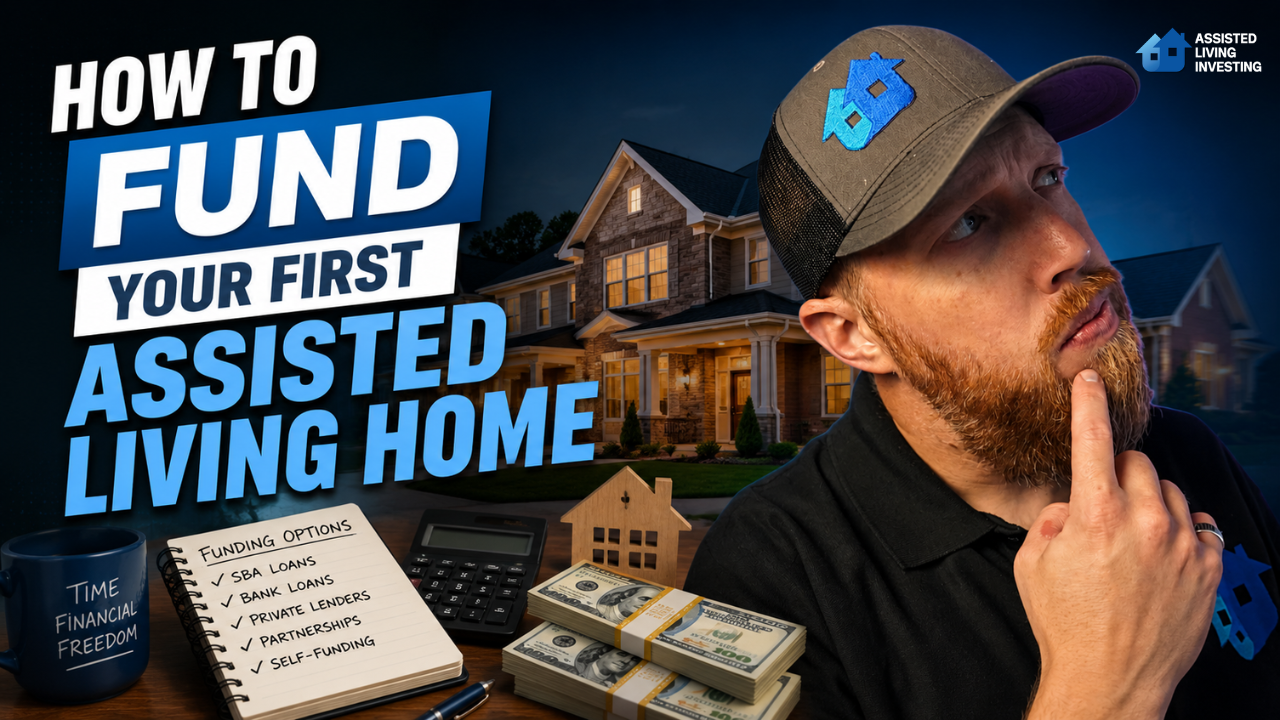
Funding your first assisted living home can feel like the biggest hurdle. I’ve seen many people get stuck because they think they need all the money before they can even begin, but there are several ways to fund your first home.
Want the full breakdown? Watch the video below👇
You have more than one way to fund your first home
I teach something called the Cash Compass. It helps you look at four main ways to find funding: creative strategies, assets you own, strategic partnerships, and help from programs.
Creative strategies can include seller financing, lease-to-own options, subject-to deals, or other real estate strategies.
Assets you own could include money, a home, a HELOC, investments, or a 401(k). Before using these, talk with your tax strategist so you understand the impact.
Strategic partnerships mean working with someone who has money or resources you may not have. You bring your skills, knowledge, and ability to run the business.
Help from programs can include SBA loans, HUD loans, local government programs, and grants. Grants can be harder to get, especially for a new for-profit business, but they do exist.
💡 You do not have to choose only one funding option. You can combine several strategies to build your first assisted living business.
A strong business plan helps people say yes
Whether you are talking with a lender, investor, or partner, they need to see that you have a real plan.
Your business plan should show how you will run the assisted living home, serve residents, and become profitable. A lender also needs to know that your business can make the loan payments.
An investor wants to understand how they can get a return on their money. That is why your numbers matter so much.
Before you ask for funding, build these three things:
✅ Your business plan
✅ Your market research
✅ Your underwriting
These three pieces show that you have thought through the business.
Do the work before you ask for the money
One of the biggest mistakes I see is asking for money too early. I understand why. Funding feels like the biggest and scariest part of getting started.
But if you approach a lender before you are ready, you may get a quick no.
Instead, start building your foundation first. You can work on your business plan, market research, and underwriting before you have any money.
You can also use your underwriting to understand how many beds you may need, what your costs could look like, and whether the numbers make sense.
That work helps you find the right property instead of trying to make any property work.
Do not be afraid of strategic partnerships
Giving up equity can feel scary. You may think, “I want this business to be mine.”
But sometimes sharing part of a business can help you build something much bigger.
I like to think about it as making your own pie. You could make a small pie by yourself, or you could work with a partner and make a much bigger pie together.
You may own a smaller percentage, but your share of the bigger business could be worth more.
💡 A good partnership can bring money, experience, support, and new opportunities. Just make sure you do your due diligence and work with the right legal professionals to set up the partnership properly.
Build your foundation before you chase the funding
You do not need to have everything figured out today. Start with the work you can do now.
Build your business plan. Study your market. Work through your numbers. Then start looking for the right property and funding strategy.
The goal is not to move fast just for the sake of moving fast. The goal is to build the right foundation so you are ready when the right opportunity comes along.
Wrap Up
Funding your first assisted living home does not have to mean finding one person with all the money. Look at the Cash Compass, build your foundation, and be open to using multiple funding strategies. The boring work you do now can make the next steps much easier.
If you need help creating a business plan for your assisted living business, check out the Free Business Plan Checklist.
And if you’re ready to figure out your next step, join me for the next Roadmap Challenge where I’ll walk you through how to get started.
Show full transcript 👇
Transcript
00:00:00
Have you been trying to figure out how to get funding for your assisted living facility, but you're just like not sure how to get started, how to go find the funding, what the different funding options are, or if this is even a possibility for you? Well, this video, Your First Assisted Living Home Funding Made Easy, is going to help you understand what that actually looks like, how to move forward with it, and get the funding that you need. And this is something that I see questions on all the time. Funding remains one of the
00:00:32
biggest and strongest repeated concerns that I see for people on YouTube and Facebook, on my other social media platforms. So, I wanted to create this video for you to help be a guide to help you out as you're trying to get started on your assisted living journey. Hey friend, my name is Brandon Gustafson. I help healthcare workers start their own assisted living business, so they're not stuck trying to figure it out and know exactly what they should do next. So, if you need some help with that, make sure
00:00:58
you get over to assistedlivinginvesting.net. I've got a few resources for you. And if you need some help and you're not sure how I can help you out, take my quiz, 30-seconds ALIquiz.com. We'll have a QR code for you down here somewhere. You can scan that, go to ALIquiz.com. Would love to help you out along your path to launching your assisted living business. Now, let's get started. Again, this video, Your First Assisted Living Home Funding Made Easy, I want to talk to you about some of the different types of
00:01:27
funding that are available to you. At a very high level, just type in roadmap below, we'll get you the link. I teach something that I call the cash compass. And at a high level, I want to talk to you a little bit about what is in the cash compass. There are different ways that you can obtain funding. Number one is the C. It stands for creative strategies. So, these are things like maybe you're doing a subject to method, something that Pace Morby teaches. Or you could be doing a BRRRR strategy,
00:01:53
which is B R R R R. I believe there's four Rs. Um that they teach at BiggerPockets. There's a lot of different ways that you can get into assisted living. There's a lot of different ways you can get into real estate. There are so many creative strategies. You could be looking at seller financing. You could be looking at doing like a lease to own option. There's a lot of different creative strategies that exist that are out there and you can implement any of those strategies that you typically see in
00:02:18
traditional assisted living or in traditional real estate investing, you can implement a lot of those right here in the world of assisted living, which is really cool. The second one is A and it means assets you own. So, this is tapping into assets that you have. This could be money you have available. Maybe it's a home and you're tapping into your HELOC. Maybe it's a second home that you have that you could sell off or are part of your portfolio that you could sell off that you could access or could be
00:02:45
your like 401k, some investments that you have available. Now, before you get into any of that, make sure you're talking to tax strategists to see how that's going to impact you, but there are a lot of ways that you can take the assets that you own and get into assisted living. The S is strategic partnerships. Now, this is something that is going in finding a partner, finding somebody to help you out, an investor, a partner, somebody that has the funds that maybe you don't have and partnering with those
00:03:14
people. And now, I know that that's something that is very scary to a lot of you because you're like, I I don't want to give up ownership. I don't want to give up the decision-making ability that I would have if it were my facility and I have to share that with somebody. Now, I want to tell you something. I'm going to lean in a little bit on this one. Most people that have the money, they realize that you know how to do this better than they do. And they're not going to want
00:03:39
to make all the decisions. They want the return on their investment. They're not going to care that much as long as it's profitable and it's run correctly. And if you know you can do that, they're going to be fine and they're not going to be having their hands in the cookie jar and telling you you have to do things certain way. Now, do your due diligence, for sure. If you're going to partner with somebody, this is a big decision. You're going to be tied You're basically married to them
00:04:03
from a legal standpoint with the way that you're doing this. So, it's a big decision. Don't take it lightly, but also you're probably going to retain a lot of that decision-making capability when you do partnerships. And I don't think you should be nearly as scared of it as you are probably feeling right now while you're watching this video, okay? And the fourth one is H It stands for help from programs. So, this could be something like an SBA loan, or it could be like a local small government uh
00:04:33
loan, or possibly even grants. Grants are a different beast. They can be hard to come by. They can be hard if you're a for-profit organization. They can be really hard if you're a brand new company. There's a lot of roadblocks for grants, but I'm also here to tell you, like as a small for-profit business owner, have secured over a million dollars in grant funding. So, they are out there. You can get them, but they have to be for specific purposes. Grants are a little bit more difficult to come
00:04:58
by and to navigate than is typical. So, I just wanted to disclaimer that. But, there are a lot of different programs that are out there. There's SBA, there's HUD loans, there's the local government like community development loans that you can find. There's a lot of things out there. Now, the cool thing about the cash compass is you don't have to just pick one of those and go for it. When I was getting started, I didn't have any funds to my name. I didn't have the money to
00:05:23
get started. So, what I did is I started off with a strategic partnership, partnered with my dad who had the funds through a HELOC, through an asset that he owned, and then we were able to go and get an SBA loan, which is one of those help from programs. So, we did what I would call an ASH form of getting into assisted living from a funding perspective. And I have students that have been all over the board of using creative strategies, different assets that they've owned, strategic partnerships, and help from
00:05:52
different programs. And I would love to know of those that are out there, which one do you think is going to be the most beneficial to you? Just comment it down below. You can even just comment the first letter there, c a s o r h. I would love to hear from you which of the funding options are you considering and think is going to be the best fit for you. And if it's multiple, even better, because I think you should be using a bunch of different strategies to get started on your path. If you want to
00:06:20
learn a little bit more and kind of dive deeper into the cash compass and everything that I just talked about, type in roadmap, because I will get you a link to the next roadmap challenge. We have one coming up soon. Those are live, they're live, and I go through a lot in that program, in that challenge. There's a lot of work involved on your end. You're going to put in some work, you're going to do some homework, but you're going to come out of it with this roadmap to know exactly how to get
00:06:43
started, including the cash compass. Type in roadmap, we'd love to have you in our next roadmap challenge. Now, let's talk a little bit here about loans versus investors. This is something that a lot of people that get confused with or they get scared of, because they're trying to figure out which of these options is going to be best for me. They feel scary. I don't know how to move forward. I don't know how to actually get a loan or find an investor to help me get this. I don't
00:07:09
want to help you understand what they are looking for specifically, okay? So you know how to better prepare yourself to have a conversation, whether it's with a lender or an investor or a partner, even. The things that they want to see, number one, is that you have a plan. This is not just something that's in your brain that you're like, "Yeah, I want to do assisted living. I've been, you know, I've been a healthcare professional for the past 10, 20 years. I know how to do this better than
00:07:35
anybody else." And they're like, "Cool. How are you going to run the business?" That's what they want to see. They They to see the written plan. This is where a business plan is so important. If you're interested in learning how to write a business plan, type in BP down below, I'll get you my free business plan checklist. Or if you type in workshop, come join me in my next workshop. Uh it's a free live workshop and we'll I would love to have you there. assistedlivinginvesting.net/workshop.
00:08:00
We'll have links for all of these things down below in the YouTube description, okay? So, go grab those. Join me in the next workshop. Grab the business plan checklist. All those things are going to help you out because a lender or an investor they want to see your plan. They want to see that you've thought this through. They want to see how you're going to become profitable, what that's going to look like in the entire process behind it. They want to see that. So, you need to give it to them.
00:08:21
That's number one and it's so so important for you to do that, okay? They want to see, number two, that this can be profitable. They want to see that you can are showing them that they can actually make money. That if it's a lender, they're going to be able to cover the loan payment that you are getting from them. So, they need to see that. Confirm it. All right? If they don't feel confident that you can make the loan payment, they're not going to give you the money. So, you need to be able to show that. An
00:08:50
investor, they want to see some kind of return. Maybe they want you to refinance in 3 to 5 years. They want you to do like a cash out refinance. You get the money back. You pay them off. They get a return. Say it's 10% on the money that they loaned you and then you now own it outright and they've gotten this this great 10% return on their money over a 5-year period or whatever. Uh however you want to work that with with them. But they want to see that there's actually the potential that at the end
00:09:20
of it for them to get that return on their investment. So, you need to show that. That's why we do underwriting. It's a requirement when you're working with a lender, but it's also so that you can see, hey, this is the type of return that's going to work. This is makes financial sense. This is how you get investors to come and work with you. If you need some help with that, type in calculator, I'll give you my free underwriting calculator as well. Link also below in the description. So, those
00:09:44
two things they need to have because that lets them see that you have thought through this. You've built this foundation. You know what you're talking about. You know how you're going to be successful. And that's the thing that's going to help you level up even more. It's so, so important for you to do that. I actually teach you a lot about that in the workshop. So, again, type in workshop, we'll get you the link to it. Assisted Living Investing done right workshop. Love to see you over there.
00:10:09
Now, let's talk a little bit here about equity versus debt. And I think this is something that's really important for you to understand as you're trying to figure out the funding process here. So, debt it just means, "Hey, this is a loan. This is something we're going to pay back. We're going to pay it over time." Equity is something you're going to see a lot more when it comes to partnership where you have an investor. You're giving up a portion of your ownership. And sometimes that's decision
00:10:35
making and sometimes it's not. And this is why when I told you that of the cash compass, when I talked about strategic partnerships, a lot of you were probably like, "Ugh, I hate that word. I don't want to give up the ability to make decisions. I want this to be me and mine." Now, two things. One, not everybody wants the the ability to to make you change your mind. A lot of people don't. Okay? And two, sometimes two heads are better than one. Okay? Almost all the time. And the more that
00:11:10
you're able to talk through things and have a good sounding board, the better off you're going to be. So, please don't be scared to create strategic partnerships and give up some equity in your business. Now, there's something that a mentor of mine years ago, he taught me about this kind of analogy with a pie. All right? We oftentimes think of a of like this economic pie, right? There's There's this one big pie and we all get to have a slice of it and that makes up the economy.
00:11:40
And a lot of people that are close-minded around finances, that's how they think of this. Like the the the US economy, it's one big pie, right? That and that's how it exists and we're going to carve out this little tiny sliver of our own of our own from that big pie. And we're competing with everybody else. The reality is when you create an assisted living business, you are just making your own pie. And you get to have the whole pie. All right? Or if you're partnering with somebody,
00:12:08
you're going to have to share that pie with that person. So, if it's an extra partner, then it's 50/50 percent. But, you get your own pie. And if you're working with a partner and you're working together to make these pies, maybe you get more pies or maybe you make bigger pies. And more likely, you're going to make a bigger pie, which means you're going to get 50% of a pie that is, you know, it's it's 200% bigger than the one that you could have created on your own.
00:12:37
Rather than just like a little hand pie, you get like a full-on, you know, re-calendar pie that that you get to have. You get to share half of it. And you're actually going to get it more of it. So, you need to take that into consideration that even if you're going to be partnering and you're going to be giving up some equity in the business, you're going to get a bigger pie that you get to have a piece of. Equity feels really scary, by the way. It feels scary to give it away. But, it's it's also not going to be that
00:13:06
big of a deal. And if you take time from a legal perspective to set it up in a way that it protects you, then you're going to be even more fine. Now, I'm not an attorney. I suggest that you go and talk to one. But, that's what's going to allow you to actually make more money and have more success. So, build a bigger pie. Even if you get a smaller percentage of it. This is not one big US economic pie. This is you're creating your own pie factory. All right. And it should not scare you to partner with
00:13:43
somebody. Bring people in that you're giving equity to because they will help you turn out pies more quickly or turn out bigger, better pies. And you're going to be a lot happier. I hope the pie metaphor is hitting with you cuz if not and also I'm sure you're hungry now. I'm really sorry if you are. Go get a good pie. All right. If you like that part, like the video. Subscribe. Ring the bell so you get notified every time we put out content that talks about pies. All right. Now
00:14:11
let's talk a little bit more about what lenders need from you. And this is not only lenders, but also investors. Everybody that you work with is going to need some things. They need some foundational things. Number one, they need a business plan. They need to see it. Type in BP will get you to the business plan checklist. They need your market research. They need to see that you have done the due diligence, that you are confident that there are enough people, potential residents in that area, that the
00:14:38
market's not already saturated, that you're going to be able to be successful. And you need to do your underwriting. Type in calculator if you need some help with that. I got a free underwriting calculator I can send over to you. Now these three things, your business plan, your market research, and your underwriting are going to be required by a lender. An investor is going to want to see it. A partner, a good partner is going to want to see these things as well. So they want to see what's
00:15:02
actually going on. And those are the things that you have to do first. And here's the cool thing about it. You can do that right now. You don't need any money. So for those of you that are telling me, "I don't have money. That's why I can't start." You can start building a business plan now. You can start doing your underwriting and understanding the numbers and how many beds you would need to have to make whatever money you want on the back end on a monthly basis, you
00:15:27
can start doing the market research. You can start doing all of those things right now with no money. Okay? I just want to be honest with you. And I promise you, when you start taking action, start building those things, especially if you do it the right way, new opportunities are going to start coming to you like you would not believe. Okay? If you want to learn a little bit more about that, and like how to to work on those things, type in workshop down below. I have a free workshop for you, where we go through exactly these
00:15:58
things. I call them the three M's: model, market, money. Would love to have you in there. Come learn, come do a little bit of homework with me, and see what you need to do so that you can actually be successful in building your foundation. And once you do those things, that's when a lender is going to want to see a property. But up until that point, you could you could go find a property, you can go to a lender, you can say, "I've found this property. I'm under contract. I want the
00:16:25
funding." They're going to say, "Cool. Where's your business plan? Where's your market research? Where's your underwriting? Where are those things?" You have to get those things done first. If not, you're going to be in this time crunch, you're going to create a business plan, it's going to be horrible, you're going to get told no by a lender. This happened to me. That's how I know. It will happen to you if you do not do this in the right sequence. It's going
00:16:46
to evolve over time, and that's okay. But start building your business plan, and start getting familiar with the numbers, start working through those things. That's what's going to allow you to be successful, and help you narrow down to the right property and the right house as you start looking into this. Most people ask for money way too early in the process as well. And the reason why they do this is because and I'm sure this is you. And this was definitely me when I got started. You feel like it's the first
00:17:15
thing. You do. Cuz it's probably the biggest thing. It's the biggest and scariest thing for a lot of people. But the reality is that uh if you start reaching out before you are ready, before you have that foundation built, before you're in a really good spot, you're going to get a no. And that feels discouraging. And it can ruin also relationships with funding partners early on in the process because it's showing them that you're not prepared. And so the more that you can get ready
00:17:47
for this upfront, a no is going to turn from like feeling really discouraging to "Okay, what what did I miss wrong in the application?" Cuz I know my business plan feels really solid to me. Like is there a gap there? Or was it something with my underwriting? Or did you see something in the market research? Did you see something in one of those foundational things? Or is it you're just like you've hit your quota, you can't do assisted living. It opens up so many more doors for you to have a
00:18:14
conversation as you're trying to get started. So it's really important for you to do this. Build your foundation first. And then when you start asking for money, it makes that feel so much more natural for you. And makes it feel like you're going to be a lot more successful. And when you get a no, it's okay. Now the reason why so many people don't do this is they don't want to put in that foundational work upfront because it feels boring or hard. And I just got to tell you,
00:18:47
boring and hard is what helps you be successful. Okay? [laughter] Guy that I follow on LinkedIn, his name is Chad Willardson. He was talking. He just posted something just a couple days ago as of the recording of this video. And he said I he had been working on something for about 8 years. 8 years, mind you. Like this is not something that he's been working on for a few months. And you're going to go faster than this. I promise you you will. Although I have had students that have been working on this for 20 years.
00:19:17
Okay? But he's been working on something for 8 years and it felt like nothing was making traction. And then he posted on LinkedIn. Little bit cryptic cuz because he can't tell all the specifics yet cuz you know, legal things I'm sure. But he'll tell us shortly in the next few weeks I'm sure. But he said, "I just had a breakfast or I had a dinner or something with somebody the other day and this thing I've been working on for 8 years just clicked. Everything fell into place and now I'm so excited for
00:19:46
the future." That is what building your foundation is going to be for you. Now you can do this quickly. Like you can do it in a month, you can do it in 2 months, 10 weeks, whatever. You can get it done quickly. But to everybody else, once you have that thing done and then you start looking for a facility then you go under contract and you close on it, it's going to feel like you did this super fast. But you know that you put in the hard and boring work up front that allowed you to actually be
00:20:16
successful. That that period of time where you were looking and trying to get things done correctly, nobody sees that. But that's the thing that makes you feel like an overnight success to everybody else. So please put in that foundational work. Type in workshop so I can help you along your path in building that foundation. I would love to do that for you and help you out as you're trying to get started. Now we talked a lot today. We we had we had a lot of stuff in here. Talking about funding. We went through the cash
00:20:49
compass and we talked about loans versus working with investors and equity versus debt and what lenders actually need from you and why most people are asking for money too early in the process. If you found this video helpful, make sure you like the video, subscribe and ring the bell as well so you get notified every time we put out content like this. Go take the quiz ali quiz.com as well. We'll have a QR code down in the bottom of the corner of the screen. So, go check that out. And are you curious
00:21:18
about assisted living which you're not sure how to get started? At Assisted Living Investing, I help healthcare workers start their own assisted living business so they're not stuck trying to figure it out and know exactly what they should do next. And I want to remind you that it doesn't take a lot, just a little bit. Just keep going step by step by step. I promise you if you do and you are consistent and persistent, you are going to be successful. Thanks for watching and have a great day.
Download Your FREE Calculator
Stay connected with news and updates!
Join our mailing list to receive the latest news and updates from our team.
Don't worry, your information will not be shared.
We hate SPAM. We will never sell your information, for any reason.